
Last updated September 10, 2026
Full 25-point door and opener safety check with every visit - springs, cables, rollers, tracks, and your LiftMaster or Chamberlain opener included
You get a price before we start. It does not change when the truck arrives.
 Before
 After
After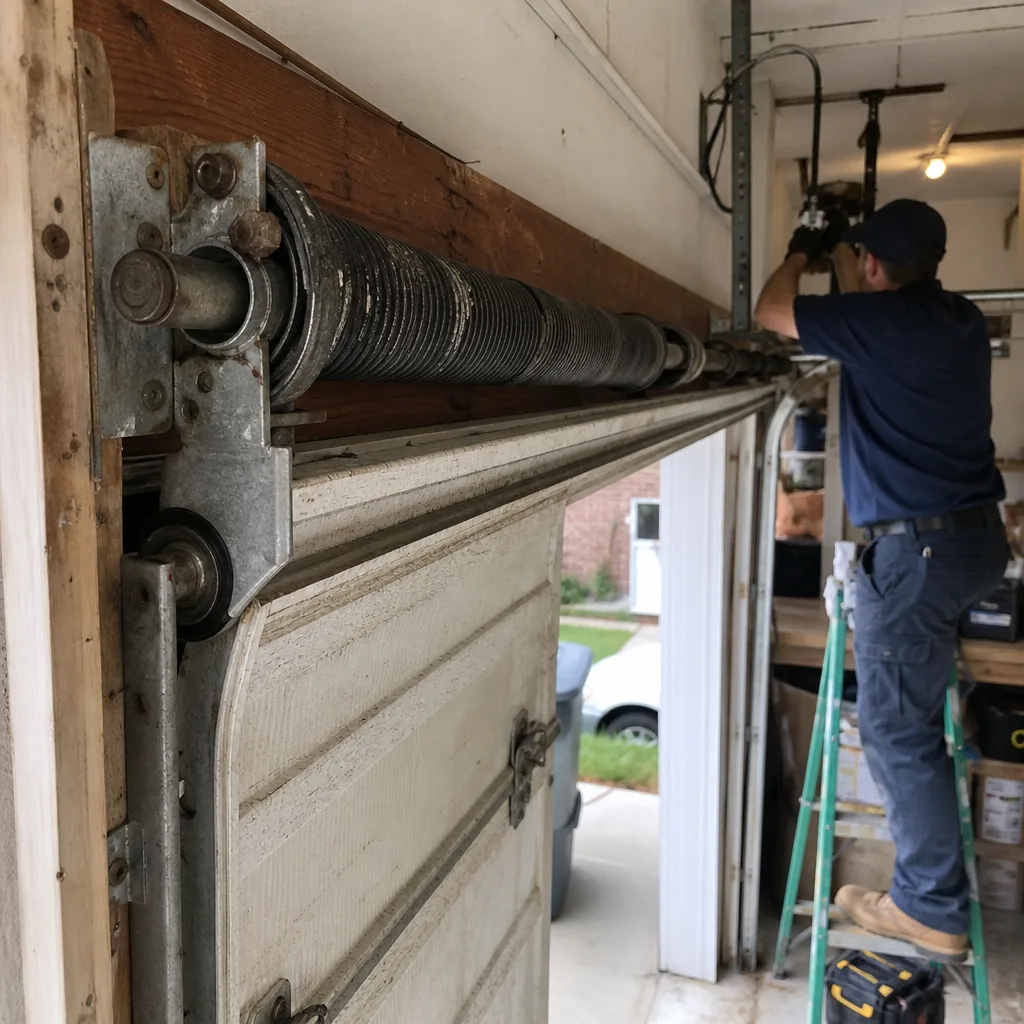 Before
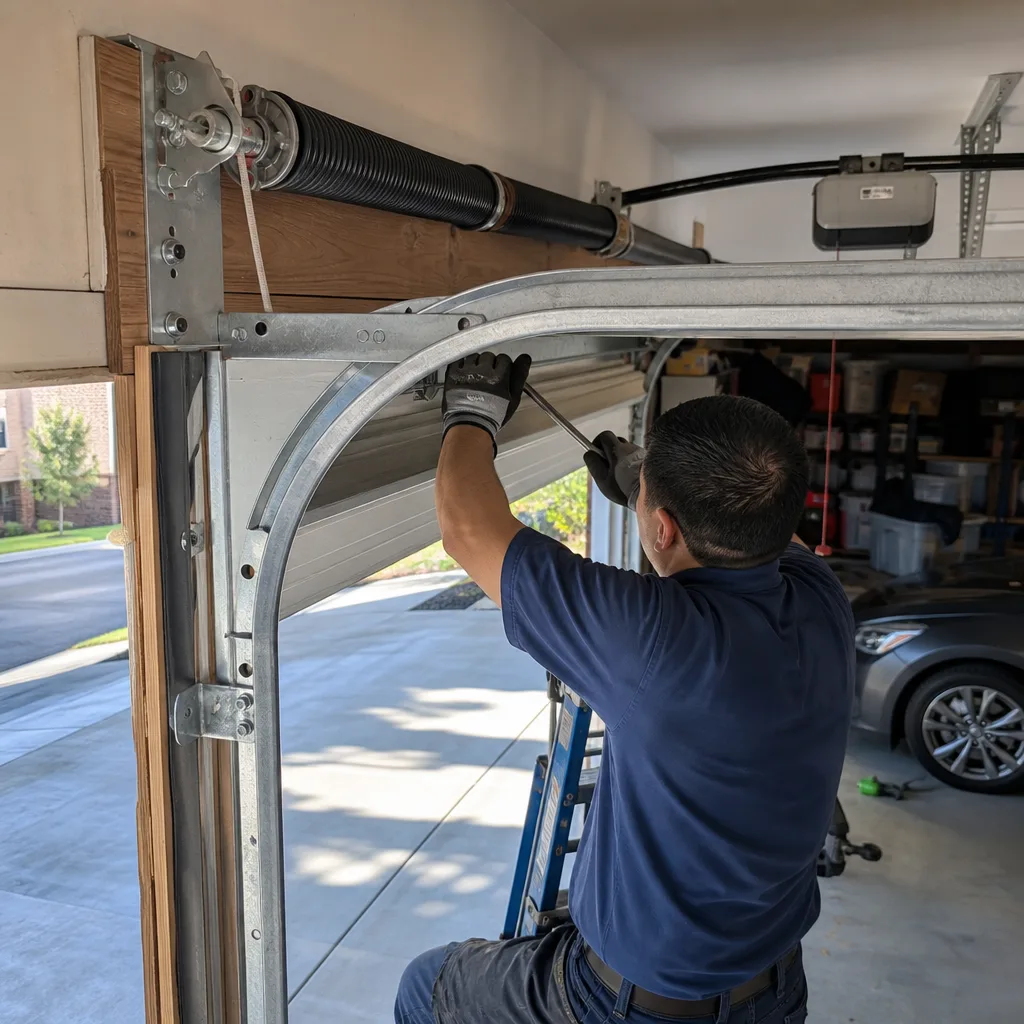 After
After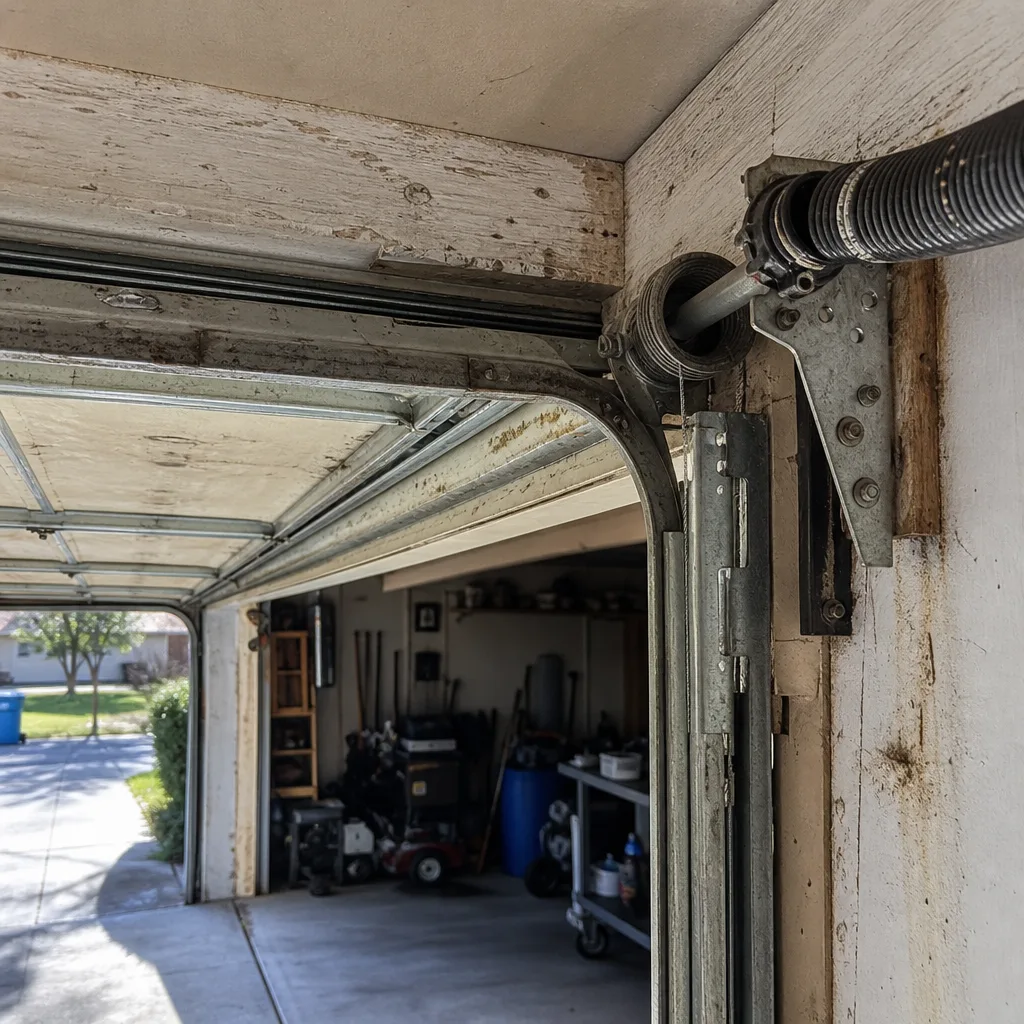 Before
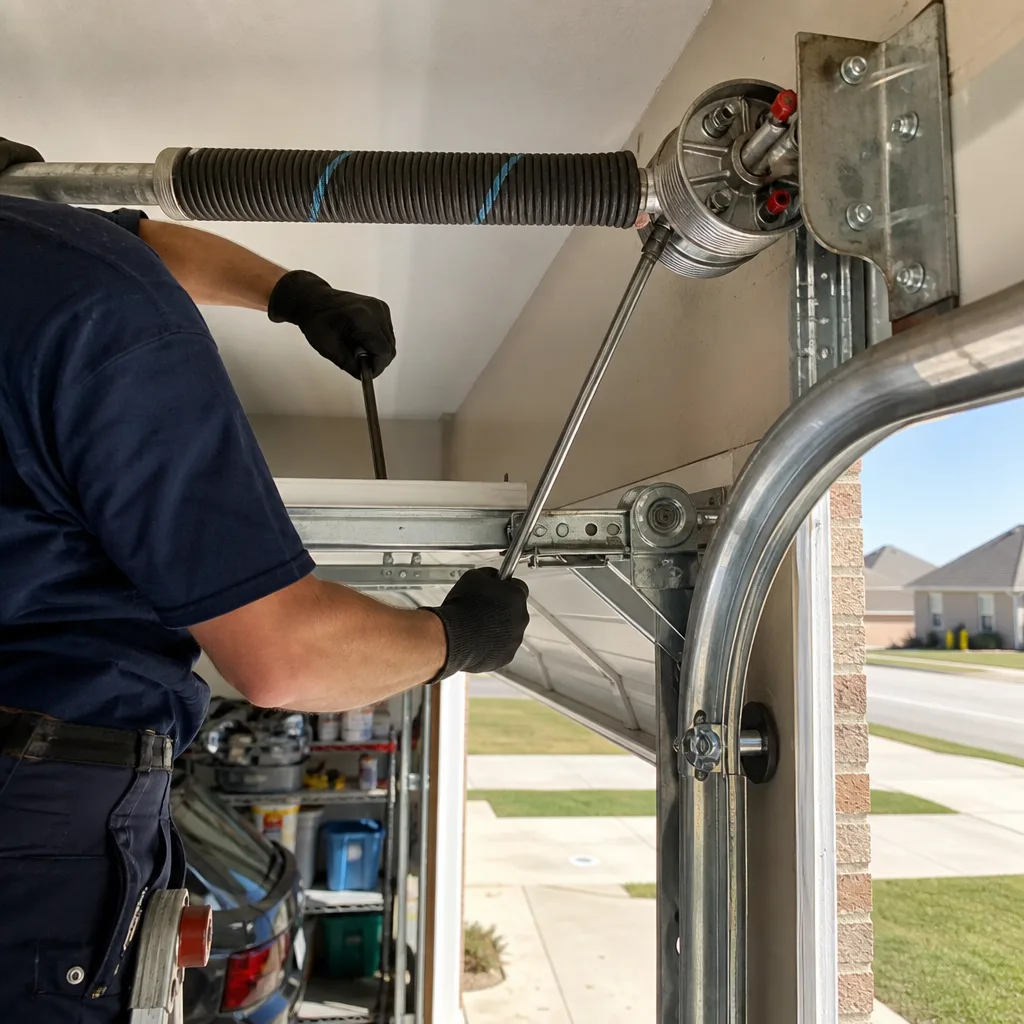 After
AfterDIY vs Professional Garage Door: The Celina Homeowner’s Decision Guide
A torsion spring above a standard two-car garage door stores roughly the same energy as a .357 magnum round when wound to operating tension. The DIY question isn’t whether you’re handy. It’s whether that risk-reward ratio makes sense for you and your family. In this guide and our more guides & resources, we’ll draw a precise line through every garage door component: what a capable Celina homeowner can safely handle, what demands professional tools and training, and the hidden costs that turn a weekend project into a second service call. You’ll learn which repairs are genuinely worth your Saturday, which ones void your warranty, and why Celina’s building codes and HOA covenants treat DIY garage door work differently from licensed contractor work when liability enters the picture.
Quick Answer
Most Celina homeowners can safely handle weatherstripping, lubrication, sensor alignment, and remote programming. Any work involving torsion springs, cables, or door balancing requires professional tools and training due to serious injury risk. For repairs beyond basic maintenance, the labor savings of DIY are typically erased by wrong parts, warranty voiding, and the cost of fixing mistakes.
Table of Contents
- The Physics of Danger: Why Torsion Springs Are Non-Negotiable
- The DIY-Safe Zone: Maintenance and Adjustments You Can Handle
- The Professional Line: Components That Demand Trained Hands
- True Cost Comparison: DIY Savings vs. Hidden Expenses
- Celina Codes, HOAs, and Liability: What the Rules Actually Say
- The One DIY Project Everyone Gets Wrong: Bottom Seal Replacement
- Warranty Traps: How DIY Work Voids Coverage
- Making the Decision: A Homeowner’s Checklist
The Physics of Danger: Why Torsion Springs Are Non-Negotiable
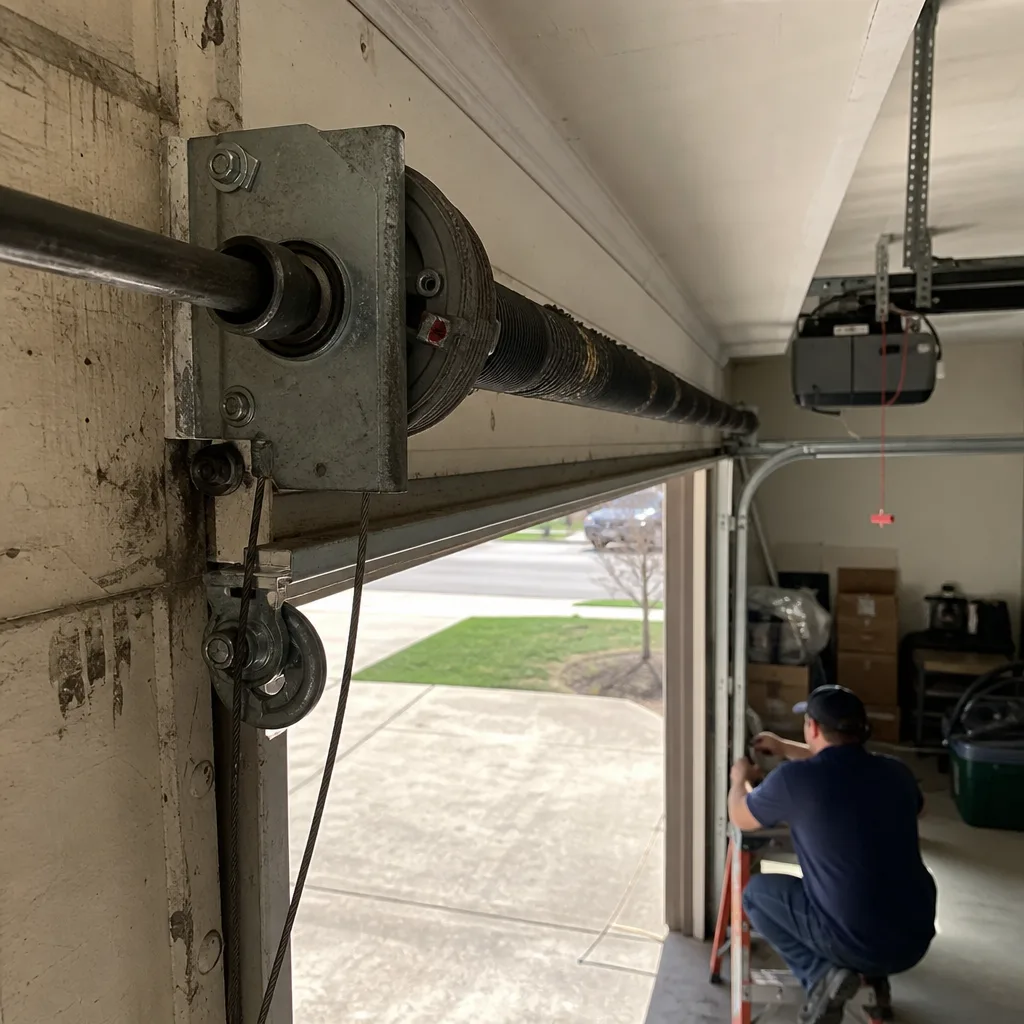
Torsion springs are the mainspring that carries your door’s entire weight. The name is not accidental. A standard 16-foot wide, 8-foot tall steel garage door weighs between 150 and 250 pounds. The torsion spring system stores the torque needed to lift that mass, and when fully wound, it holds approximately 1,000 to 1,500 foot-pounds of rotational energy.
To put this in terms that matter: if a wound torsion spring breaks or slips during adjustment, the sudden release of energy can snap steel bars, shatter bones, and cause fatal head trauma. We have seen the aftermath in Celina homes where a homeowner used a mismatched winding bar or skipped the set screws. The emergency room visits are real. The facial reconstructions are real. The springs do not care how confident you are.
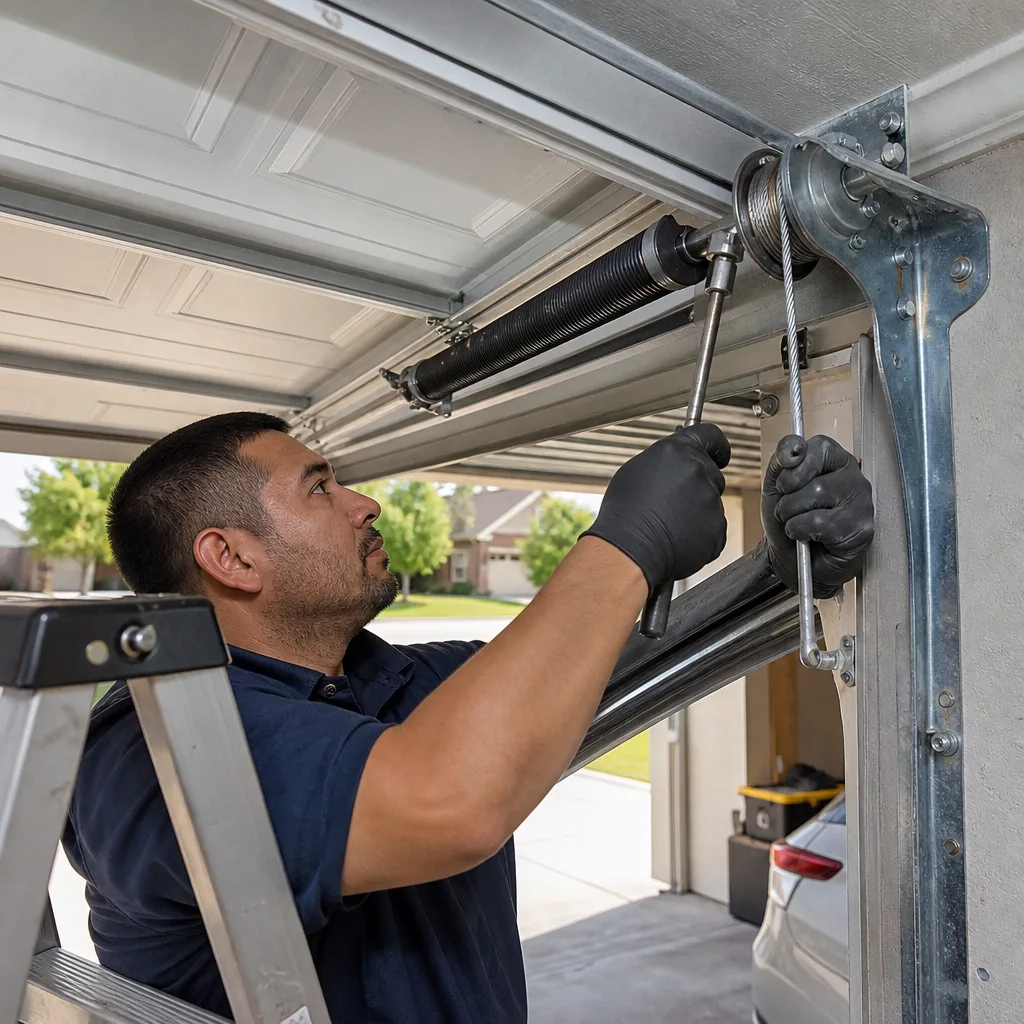
The professional tools required are not available at any Celina-area home improvement store. Proper winding bars are solid steel, precisely sized to the spring’s inner diameter, and used in matched pairs. Using a screwdriver, socket extension, or any improvised substitute is the most common cause of serious injury. A winding bar that is too short, too soft, or gripped incorrectly becomes a projectile.
Our technicians carry calibrated torque-measuring tools and follow a specific unwinding sequence that gradually releases tension in controlled stages. The K.E.Y.S. values code we train under, Krafted right, Every time, Your home first, Standing behind it, exists because this work demands discipline that cannot be learned from a ten-minute video.
Bottom line: torsion spring work is never a DIY project. Not for saving money. Not for proving capability. Not once.
The DIY-Safe Zone: Maintenance and Adjustments You Can Handle
Not every garage door task carries catastrophic risk. Several components are designed for homeowner access, and performing this maintenance regularly-tracked in our Garage Door Repair Maintenance Checklist for Celina Homeowners-will extend the life of your system and reduce your service calls over time.
1. Visual Inspection (15 minutes, quarterly)
With the door closed and the opener disconnected, examine the rollers, hinges, and tracks for visible wear or damage. Look for rust on the bottom fixtures, cracks in the roller wheels, and bent track sections. In Celina, where spring storms can blow debris into the track and summer heat accelerates lubricant breakdown, this inspection catches problems before they become emergencies.
2. Lubrication (20 minutes, twice yearly)
Use a silicone-based spray lubricant on the hinges, rollers, and bearing plates. Avoid WD-40 for this purpose; it is a solvent, not a lubricant, and will strip away the grease that protects moving parts. Apply sparingly. Wipe excess. Run the door up and down manually to distribute. This is simple work that pays real dividends in noise reduction and wear prevention.
3. Safety Sensor Alignment (10 minutes, as needed)
Photo-eye sensors sit four to six inches above the floor on both track sides. When the LED indicator on one sensor glows steady and the other blinks or stays dark, they are misaligned. Loosen the wing nut, pivot the sensor until both LEDs match, then retighten. Test by closing the door and waving an object through the beam. The door should reverse immediately.
4. Remote and Keypad Programming (varies, as needed)
Most Chamberlain, Genie, and LiftMaster openers use a learn button on the motor housing. Press and release, then press the remote button within 30 seconds. For keypads, the sequence is typically enter-current-PIN, press learn button, enter new PIN. Your owner’s manual specifies the exact steps; if the manual is lost, manufacturer websites archive most models by date code.
5. Weatherstripping Inspection (5 minutes, before winter)
Check the rubber seal along the door’s bottom edge and the vinyl or brush seals on the frame sides. Look for cracking, hardening, or gaps that let wind and water through. Replacement of these seals is DIY-appropriate with the correct profile; we cover the specific method in a dedicated section below.
These tasks share a common trait: none involve stored mechanical energy, electrical panel work, or load-bearing components. They are maintenance, not repair. They preserve function rather than restore it.
The Professional Line: Components That Demand Trained Hands
Beyond the torsion springs, several garage door systems require specialized knowledge, tools, or carry sufficient risk that professional service is the only responsible choice.
Cable Repair and Replacement
Lift cables run from the bottom brackets to the drum at each end of the torsion shaft. They are under constant tension, even when the door appears at rest. A frayed or snapped cable can whip unpredictably. More critically, the bottom brackets are attached to the door with fasteners that also anchor the spring’s counterbalance force. Removing these brackets without first releasing spring tension causes immediate, uncontrolled door drop. We have responded to calls in Celina’s Light Farms and Mustang Lakes neighborhoods where a homeowner’s cable replacement attempt ended with a door off its tracks and damage to the vehicle inside.
Door Balancing and Spring Calibration
A properly balanced door stays in place when opened to waist height and released. If it rises or falls on its own, the spring torque is incorrect. Adjusting this requires winding or unwinding the torsion spring, which returns us to the physics discussed above. Even extension spring systems, which run parallel to the horizontal tracks, use stretched springs under significant load and require safety cables to contain them if they break.
Track Realignment and Replacement
Bent or misaligned tracks cause rollers to bind and jump. Straightening a track section without understanding the precise spacing from the door face, the vertical plumb, and the horizontal slope results in accelerated wear and eventual failure. Our trucks carry track gauges and replacement sections for all common profiles because field-bending rarely produces a lasting repair.
Opener Installation and Electrical Work
Garage door openers require a dedicated electrical outlet within six feet of the motor unit, per National Electrical Code. Hardwired installations demand proper gauge wire, strain relief, and grounding. The force and limit settings must be calibrated to the specific door weight and spring balance. A Genie or Chamberlain opener installed on an unbalanced door will strain its motor, strip its drive gear, and fail prematurely. The manufacturer warranty specifically excludes damage from improper installation.
Panel and Section Replacement
Modern sectional doors use stamped steel panels with internal reinforcement struts. Replacing a damaged section requires releasing the hinge fasteners, supporting the door’s weight during the swap, and verifying that the replacement panel matches the original gauge and insulation value. Mismatched panels create binding, poor sealing, and aesthetic inconsistency that affects resale value in Celina’s planned communities.
Bottom Bracket and Hardware Replacement
These brackets connect the lift cables to the door and transfer all spring force. They are marked with warning labels for good reason. Any fastener that carries spring load must be treated as part of the counterbalance system, not as general hardware.
Garage Door Repair in Celina covers the full scope of professional services for these components.
True Cost Comparison: DIY Savings vs. Hidden Expenses
The advertised price of a torsion spring online, roughly $30 to $80, creates an illusion of savings. The complete calculation, as we break down in our Garage Door Cost Breakdown: The Celina Homeowner’s Reference for 2026, tells a different story.
| Cost Factor | DIY Approach | Professional Service |
|---|---|---|
| Parts (springs, cables, rollers) | $30-$150 online, often wrong size or grade | Included in flat-rate quote, correct specification guaranteed |
| Specialized tools | $80-$200 for winding bars, vice grips, torque gauge | Technician arrives equipped |
| Wrong parts ordered | Common: spring wire size, length, or wind direction mismatched | Measured and matched on-site from stocked inventory |
| Second service call for DIY errors | $150-$350 to fix door off tracks, damaged panels, or opener strain | Not applicable; done right the first time |
| Warranty voided on opener or door | Full replacement cost if manufacturer denies claim | Work documented, warranty preserved |
| Time invested | 4-8 hours research, ordering, attempting, correcting | 1-2 hours, door operational same visit |
| Injury risk cost | Emergency room, lost work, long-term disability | Borne by licensed, insured contractor |
In our 42 years of service, we have observed a consistent pattern. The homeowner who calls after a DIY attempt typically spends 40% more than the original professional quote would have cost. The math is not complicated. It is simply incomplete when viewed from the parts price alone.
Our Mainspring Garage Door Co. home page details our flat-rate pricing structure. The price is stated before any work begins. There are no surprises on the bill.
Celina Codes, HOAs, and Liability: What the Rules Actually Say
Celina’s rapid growth from farming community to master-planned destination has created a layered regulatory environment that DIY garage door work can trigger in unexpected ways.
The City of Celina adopts the International Residential Code with local amendments. Garage door installations in new construction and significant remodels require permits when structural modifications occur, such as widening the opening or altering the header support. Simple component replacement on an existing door generally does not require permitting, but the distinction matters for insurance purposes.
More consequential are the HOA covenants in Celina’s newer developments. Light Farms, Mustang Lakes, and the various phases of Trinity Falls maintain architectural control committees with specific requirements for door style, color, and hardware visibility. A DIY panel replacement with a mismatched design can generate a compliance notice and mandatory re-replacement at homeowner expense. We have assisted Celina residents in selecting replacement doors that satisfy both HOA guidelines and personal preference, documenting the approved specifications in writing.
Liability presents the sharpest edge. If a DIY repair fails and damages property or injures a person, the homeowner’s insurance policy may deny coverage if the work was performed without appropriate licensing. Professional contractors carry general liability and workers’ compensation insurance that transfers this risk. In a litigious environment, this transfer has real financial value beyond the repair itself.
Celina’s position on the Collin County prairie also means specific climate considerations. Summer temperatures regularly exceed 100 degrees, accelerating lubricant breakdown and thermal expansion in metal components. Winter cold snaps, though brief, can make brittle old springs more prone to fracture. These patterns inform our maintenance recommendations and our stocking decisions; our trucks carry springs rated for the temperature cycling this region demands.
The One DIY Project Everyone Gets Wrong: Bottom Seal Replacement
Bottom seal replacement appears simple. It is not difficult, but the method most homeowners use produces a temporary fix that fails within months. Here is the correct approach.
- Identify the exact retainer profile. Garage door bottom retainers come in single-channel, double-channel, T-slot, and bulb-style configurations. The replacement seal must match the retainer’s interior shape. Remove a six-inch section and bring it to a supplier, or photograph it with a ruler for scale.
- Measure the door width precisely, then add one inch. The seal compresses slightly during installation and shrinks over time. Cutting exactly to width leaves gaps at the ends within a year. In Celina, where north winds drive rain against garage doors during spring storms, these gaps admit water that damages stored items and promotes concrete spalling.
- Lubricate the retainer channel with silicone spray. Dry insertion requires excessive force, stretches the seal unevenly, and tears the bulb. A light silicone coating allows smooth, consistent feeding.
- Feed from one end, do not stretch. Push the seal’s T-end into the retainer without pulling or tensioning the material. Stretching creates thin spots that wear prematurely and recoil that pulls the seal out of the retainer at the ends.
- Trim the excess, then crimp the retainer ends. After achieving full width coverage, trim the overhang to half-inch beyond each end. Use pliers to slightly crimp the retainer channel at both ends, creating a mechanical lock that prevents seal migration.
- Test with the door closed on a flat surface. The seal should compress evenly across the full width with no visible gaps. Adjust by tapping the retainer mounting screws if the concrete floor has settled unevenly, common in Celina’s clay soils.
The mistake we see repeatedly: homeowners buy universal seal kits, cut to exact width, and force the installation dry. The result is a seal that leaks within a season and often pulls completely free. The extra twenty minutes of proper method produces a repair that lasts years.
Warranty Traps: How DIY Work Voids Coverage
Manufacturer warranties on garage door components contain specific exclusions that DIY work triggers automatically. Understanding these provisions before beginning any repair protects your long-term investment.
Door panel warranties typically cover factory defects in materials and workmanship for ten to twenty years, depending on the series. They exclude damage from improper installation, impact, and modifications not performed by authorized dealers. Replacing a panel yourself, or having an unqualified installer do so, voids the remaining coverage on the entire door system in many Clopay and Amarr policies.
Opener warranties from Chamberlain, Genie, and other major manufacturers require installation by a qualified technician for full coverage. The force setting calibration, safety reverse testing, and travel limit programming are specified as dealer-performed procedures. A DIY installation that subsequently fails due to motor strain from an unbalanced door will be denied.
Spring warranties offered by some suppliers cover premature fatigue failure. They require installation with matched spring pairs of identical specification. A homeowner who replaces one spring of a pair, or substitutes a different wire size or cycle rating, voids this protection.
Workmanship warranties from professional installers cover the installation quality itself. Our 90-Day Done Right Promise, stated in writing on every job, ensures that if anything is not right, we return at no charge. No paperwork, no arguing. This protection simply does not exist for DIY work.
The financial exposure is concrete. A voided opener warranty means full replacement cost, $300 to $600 for mid-range models. A voided door warranty on a premium insulated system can exceed $2,000. The savings from avoiding a service call are dwarfed by these potential exposures.
Garage Door Opener in Celina details our installation and service coverage for all major brands.
Making the Decision: A Homeowner’s Checklist
Use this framework to evaluate any garage door task before beginning.
- Does the work involve torsion springs, lift cables, or bottom brackets? If yes, stop. Call a professional.
- Does the work require electrical connection beyond plugging into an existing outlet? If yes, consider a professional, especially for hardwired opener installations.
- Will the manufacturer warranty require dealer installation to remain valid? If yes, factor the voided coverage into your cost calculation.
- Do you have the correct tools, not approximate substitutes, for every step? If no, the tool cost often exceeds professional labor.
- Can you verify the exact part specification from your door’s serial number and date stamp? If not, wrong parts are likely.
- Does your HOA or Celina’s amended building code require licensed contractor work for this modification? If yes, compliance failure carries penalties.
- If the repair fails, can you absorb the cost of property damage, injury, and a subsequent professional fix? Be honest about this. We have seen the consequences when the answer was assumed rather than considered.
When six or more of these point toward professional service, the decision is clear. When four or fewer do, the task may be genuinely DIY-appropriate with proper preparation.
Common Mistakes to Avoid
- Using mismatched winding bars for spring work. Solid steel bars of precise diameter are mandatory. Socket extensions, screwdrivers, or rebar substitute poorly and have caused serious injuries in Celina and across Collin County.
- Replacing only one spring of a pair. Springs fatigue together. The unworn spring carries disproportionate load after replacement and fails prematurely, often within months, requiring a second service call.
- Lubricating the track itself. Rollers need lubrication; tracks need cleanliness. Grease in the track collects grit and accelerates wear. We clean tracks with solvent during every service visit.
- Ignoring the door balance after opener installation. A new Chamberlain or Genie opener on an unbalanced door strains the motor and strips the drive gear within two years. Balance verification is part of professional installation.
- Buying parts by door size rather than spring specification. Spring selection requires weight, drum diameter, track radius, and desired cycle life. A 16-foot door in Celina’s newer construction may use different springs than a 16-foot door from 1995 due to insulation and steel gauge differences.
- DIY sensor alignment without testing the reverse function. Misaligned sensors that still show steady LEDs can fail under vibration. The two-by-four test, placing a board flat on the floor and verifying reversal on contact, is the only confirmation that matters.
When to Call a Professional
Call a professional when the work involves stored mechanical energy, load-bearing hardware, electrical installation, warranty-sensitive components, or any task where failure would damage property or harm a person. This describes most garage door repairs beyond basic maintenance.
Specific scenarios: a broken spring or cable, a door that has come off its tracks, an opener that hums but does not move the door, visible panel damage after impact, and any repair needed when your vehicle is trapped inside and you cannot afford a second attempt.
Garage Door Installation in Celina addresses new door and replacement projects that require measurement, ordering, and precise installation.
Mainspring Garage Door Co. offers free estimates in Celina. Call (214) 480-4855. A live person answers, 24/7, including nights, weekends, and holidays. We arrive with the right parts on the truck, state the flat price before any work begins, and back every completed job with our 90-Day Done Right Promise in writing.
Frequently Asked Questions
Professional torsion spring replacement in Celina typically ranges from $180 to $340 for a standard residential door, including parts, labor, and warranty. The exact price depends on spring size, single or double spring configuration, and whether additional components like cables or bearings require replacement. We provide an exact quote after inspection, with no obligation. Call (214) 480-4855 for a free estimate.
Plug-in opener replacement is within capable homeowner range if the existing door is properly balanced and the mounting bracket is compatible. Hardwired installations, force setting calibration, and safety reverse testing are best left to professionals. DIY opener installation voids most manufacturer warranties and risks motor damage if the door balance is incorrect. For most Celina homeowners, professional installation pays for itself in preserved warranty coverage and correct calibration.
No. At Mainspring Garage Door Co., the flat price is stated before any work begins. If we discover additional needed repairs during inspection, we explain the finding and quote the additional work separately. You approve every dollar before we proceed. There are no surprises on the bill.
Warning signs include a loud bang from the garage, visible gaps in the spring coils, the door feeling heavier to lift manually, the opener straining or stopping mid-cycle, and the door dropping rapidly when released from the opener. In Celina’s climate, springs typically last 7 to 12 years depending on cycle frequency. If your springs show any of these indicators, schedule inspection before failure leaves your vehicle trapped or the door unbalanced.
Possibly. If DIY work causes damage or injury, your insurer may deny coverage if the work required licensing you did not hold. Professional contractors carry general liability and workers’ compensation insurance that transfers this risk. For Celina homeowners in master-planned communities with HOA covenants, unlicensed modifications may also trigger compliance violations with separate financial penalties.
Quarterly visual inspection, twice-yearly lubrication of hinges and rollers with silicone spray, safety sensor alignment and testing, remote battery replacement, and weatherstripping inspection are all DIY-appropriate. Given Celina’s temperature extremes and occasional severe storms, pay particular attention to track cleanliness after high winds and lubricant condition before summer heat peaks. These simple tasks prevent most emergency service calls.
The Bottom Line
The DIY versus professional decision for garage door work is not about handiness or cost-cutting ambition. It is about objective risk assessment. Maintenance tasks, visual inspection, lubrication, sensor alignment, and careful weatherstripping replacement are genuinely within homeowner capability and worth your time. Any task involving torsion springs, cables, door balancing, electrical work, or warranty-sensitive installation demands professional training, proper tools, and insurance-backed accountability.
The hidden costs of DIY, wrong parts, voided warranties, second fixes, and the small but real chance of serious injury, erase the apparent savings on most repairs. In Celina’s growing community, where homes represent significant investment and HOA compliance matters for resale, professional work protects value as well as safety.
We have served this region for over 42 years. We arrive when we say we will, quote the flat price before the wrench comes out, and stand behind every job for 90 days in writing. That is a square deal. It is also the reason we are still here when homeowners need us again.
Written by Carl Dutton, Owner at Mainspring Garage Door Co., serving Celina since 2016.