
Last updated September 10, 2026
Full 25-point door and opener safety check with every visit - springs, cables, rollers, tracks, and your LiftMaster or Chamberlain opener included
You get a price before we start. It does not change when the truck arrives.
 Before
 After
After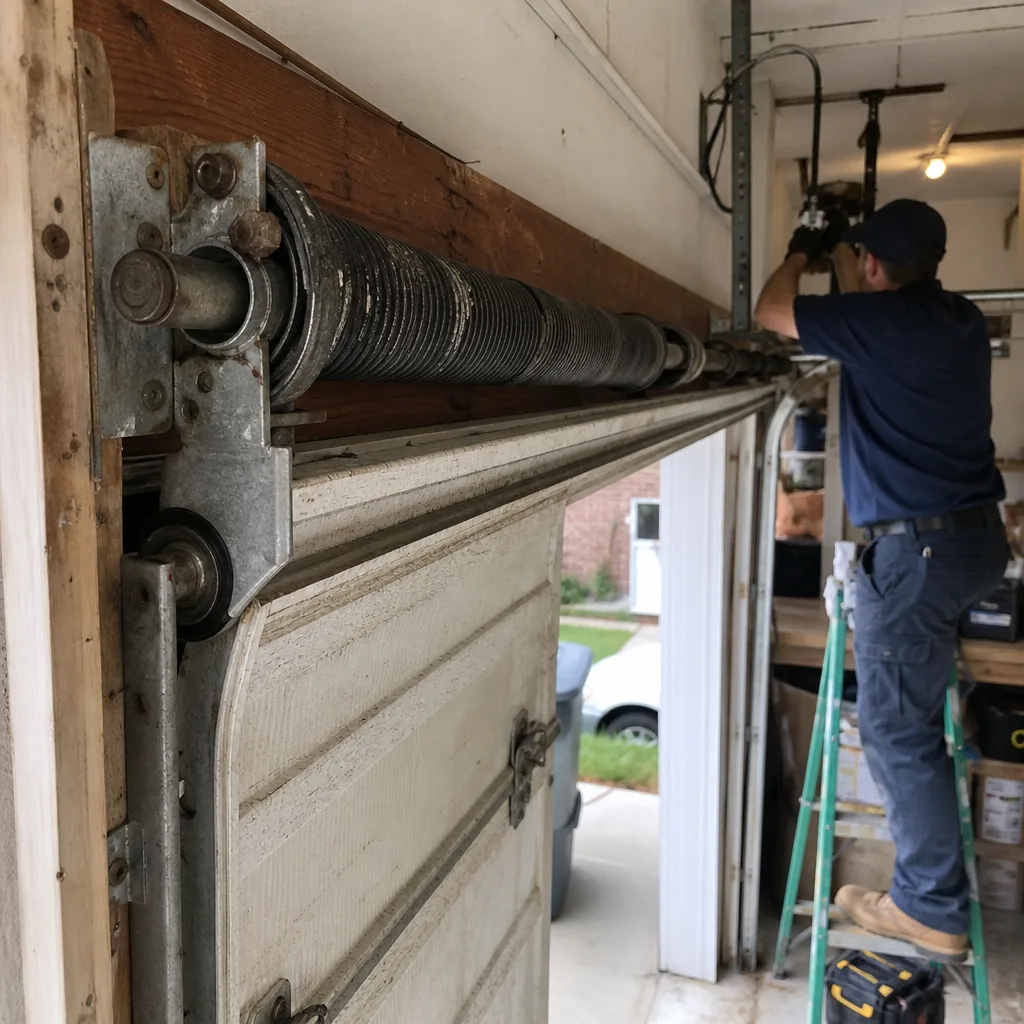 Before
 After
After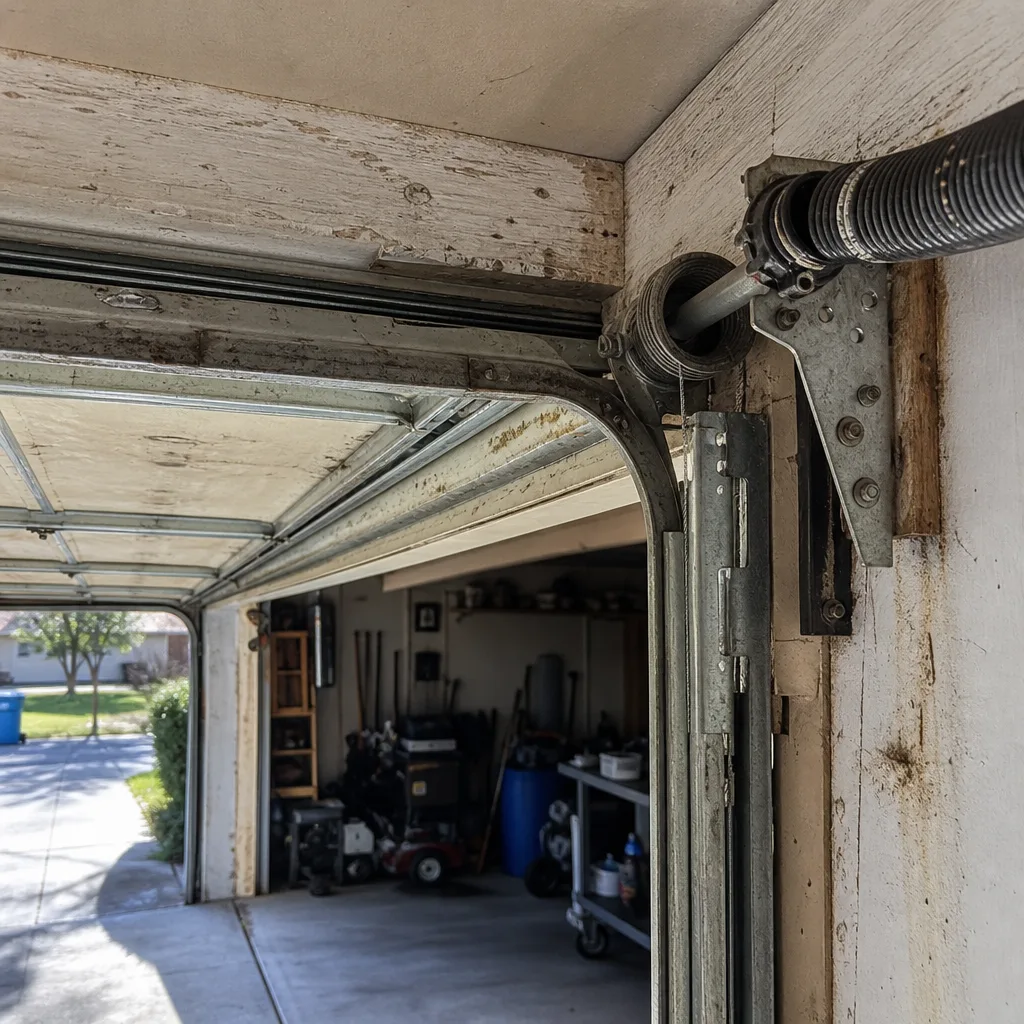 Before
 After
AfterGarage Door Warning Signs: A Celina Homeowner’s Reference Guide
A loud garage door is not necessarily a dangerous one. A quiet door that takes three seconds longer to open than it did last month may be days from a spring failure, and it’s the quiet door that gets ignored. In Celina, where summer heat pushes metal components past 140 degrees and many households run three or more cycles daily, the warning window between first symptom and full failure is shorter than most homeowners realize. This guide - alongside our Complete Guide to Garage Door in Celina - teaches you to read your garage door the way our technicians do: by what the symptom points to, not just what it sounds like. You’ll learn the 90-second inspection path we walk on every service call, the three signs that mean stop using the door immediately, and why cosmetic noise matters less than structural lag.
Quick Answer
The most critical garage door warning signs for Celina homeowners are: visible cable fraying or slack, a door that opens unevenly or stalls mid-travel, and an opener that hesitates or reverses without obstruction. These indicate mechanical failure in progress, not normal wear. Squeaks and rattles are maintenance issues; cable damage, spring fatigue, and track misalignment are safety hazards that can cause the door to drop or jam without warning.
Table of Contents
- Cosmetic Noise vs. Structural Symptoms: Knowing the Difference
- Reading Your Opener: Diagnostic Signals Most Homeowners Miss
- The 90-Second Visual Inspection Path
- Why Celina’s High-Use Households Face a Compressed Warning Window
- Three Warning Signs That Mean Stop Using the Door Immediately
- Seasonal Maintenance: When to Check and What to Look For
- Common Mistakes to Avoid
- When to Call a Professional
- Frequently Asked Questions
- The Bottom Line
Cosmetic Noise vs. Structural Symptoms: Knowing the Difference
Most homeowners in Celina call us because their door “got loud.” The noise is easy to notice. It announces itself every morning at 6:15. But noise is often the least informative symptom, and fixing it can distract from what actually needs attention.
Cosmetic symptoms are sounds and vibrations that indicate wear, friction, or looseness. They are irritating. They may worsen over months. They rarely cause sudden failure:
- Squeaking or squealing during travel - usually dry rollers or hinges needing lubrication
- Rattling hardware - nuts and bolts loosening from vibration cycles
- Grinding at the motor housing - often worn opener gears, not the door itself
- Vibration in the rail - loose rail mounting brackets or worn trolley
Structural symptoms indicate that a load-bearing component is failing. These are quiet, gradual, and dangerous:
- Uneven door gap: One side sits higher than the other when closed, signaling a fatigued or broken spring on the low side
- Door lag: The door takes longer to start moving after the opener engages, or moves slower through the full travel
- Visible cable slack: A loose or drooping cable means the spring system is not balancing the door’s weight properly
- Track misalignment: Rollers pressing against one side of the track, visible as scraping marks or bent track flanges
In our 42 years of service, we’ve replaced thousands of springs in Celina and the surrounding communities. The homeowners who describe a “sudden” failure almost always had structural symptoms for weeks. They noticed the squeak and ignored the lag. The spring broke on a Tuesday morning when the door was already struggling to lift, and they were surprised.
The distinction matters because the fix for a cosmetic symptom is maintenance. The fix for a structural symptom is repair, and the window for safe repair closes fast. A door with a fatigued spring can still open. A door with a broken spring that snaps while in motion can drop with hundreds of pounds of force, or jam crooked in the tracks with a car trapped inside.
Our Garage Door Repair in Celina service addresses both categories, but we want every homeowner to know which phone call is urgent and which can wait for the next tune-up.
Reading Your Opener: Diagnostic Signals Most Homeowners Miss
Your garage door opener is not just the motor that moves the door. It is a diagnostic tool that reports mechanical condition through behavior changes. Most homeowners in Celina interpret opener problems as electrical or remote issues. Often, the opener is struggling because the door has become mechanically harder to move.
Here is what specific opener behaviors indicate:
Hesitation at Start or Mid-Travel
The motor engages, the light comes on, but the door waits a half-second before moving. Or it stops briefly at the same point in travel, then continues. This is not a remote battery problem. The opener’s force sensors are detecting resistance higher than the calibrated threshold. Causes include:
- Dry or seized rollers creating drag in the track
- A spring losing tension and forcing the motor to carry more of the door’s weight
- A bent track section that rollers are binding against
- Worn bearings in the idler pulley or spring anchor bracket
In Celina’s summer heat, metal expansion can temporarily worsen binding that was minor in cooler months. A door that hesitated occasionally in March may stall completely in August.
Reversal Without Obstruction
The door travels partway down, then reverses to the open position. The safety sensors are clean and aligned. This behavior means the opener’s force limit is being exceeded during the close cycle, which triggers the auto-reverse as a safety response. The door is physically harder to close than the system expects.
Common mechanical causes: a fraying cable that is binding in the drum, a door section that has shifted and is rubbing the track, or a broken spring on one side creating uneven downward force. We see this frequently on Wayne Dalton and Amarr doors with torsion systems where one spring has fatigued before the other.
Grinding or Labored Motor Sound
The motor runs louder and longer for the same travel distance. The door still opens, but the opener sounds strained. This indicates the motor is drawing more current to overcome mechanical resistance. Continued operation will overheat the motor and burn out the drive gears. The mechanical problem - usually spring fatigue or track misalignment - will outlast the opener if not addressed.
On Craftsman and Raynor chain-drive openers common in Celina’s older subdivisions, this symptom often precedes stripped drive gears by two to four weeks. Catching it early means repairing the door, not replacing the opener.
Failure to Complete Travel
The door stops short of fully open or does not seal completely at the bottom. If the opener travel limits have not been adjusted manually, this indicates the motor is hitting its thermal overload or force limit before completing the programmed distance. The door has become too heavy or too resistant for the opener’s rated capacity.
This is a critical warning. An opener should not struggle to move a properly balanced door. If it does, the spring system is failing. Operating in this condition risks burning out the opener and, more seriously, a sudden spring failure with the door in motion.
Our Garage Door Opener in Celina page covers replacement and upgrade options, but we always diagnose the door first. Installing a stronger opener on a failing door is the wrong fix, and we won’t do it.
The 90-Second Visual Inspection Path
Every technician at Mainspring walks the same inspection path on arrival. It takes 90 seconds and requires no tools. You can replicate it safely from the ground, without touching springs or cables under tension.
Important: Do not attempt to adjust, repair, or disconnect springs, cables, or bottom fixtures. These components are under extreme tension and can cause serious injury or death if handled improperly. This inspection is visual only. If you see any of the warning signs described, call a trained professional.
Step 1: Close the Door and Step Back
With the door fully closed, stand 10 feet back and look at the bottom gap. It should be uniform left to right, no more than a quarter-inch variation. Check that the door sits square in the opening, not tilted. A tilted door means unequal spring tension. In Celina, where expansive clay soils shift foundations, door frames can go out of square and mask spring problems - or cause them. Look at the seal: is it compressed evenly, or gaping at one corner?
Step 2: Inspect the Cables
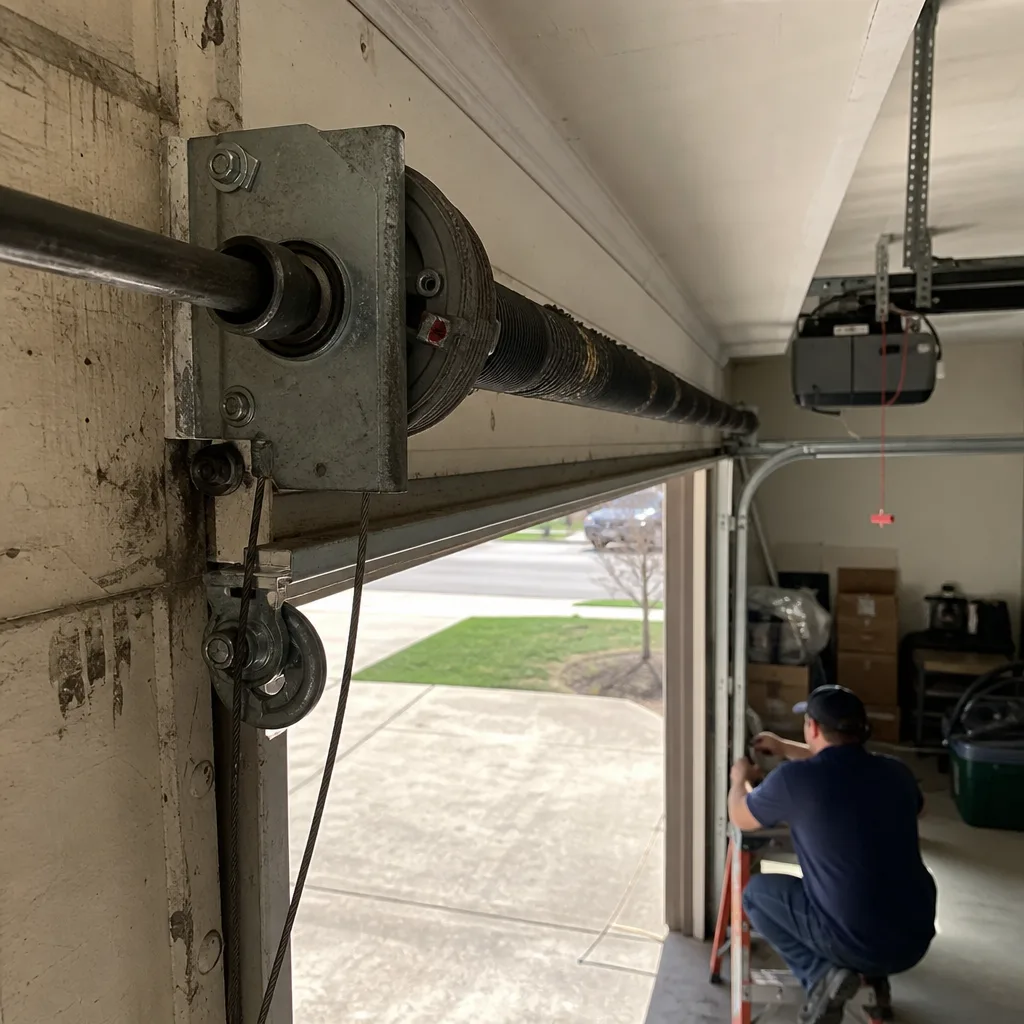
Walk to one side. Look at the lift cable where it runs from the bottom fixture up to the drum. The cable should be taut with no visible fraying, no broken strands, and no rust blooming on individual wires. A single broken strand is visible as a small whisker protruding from the cable. Multiple broken strands mean the cable is approaching failure.
Check for cable slack when the door is closed. A drooping cable means the spring on that side has lost tension or the cable has slipped on the drum. Either condition means the door is not properly counterbalanced.
Repeat on the opposite side. Asymmetric wear - one cable pristine, one frayed - is common and indicates the door has been running unevenly for some time.
Step 3: Examine the Springs
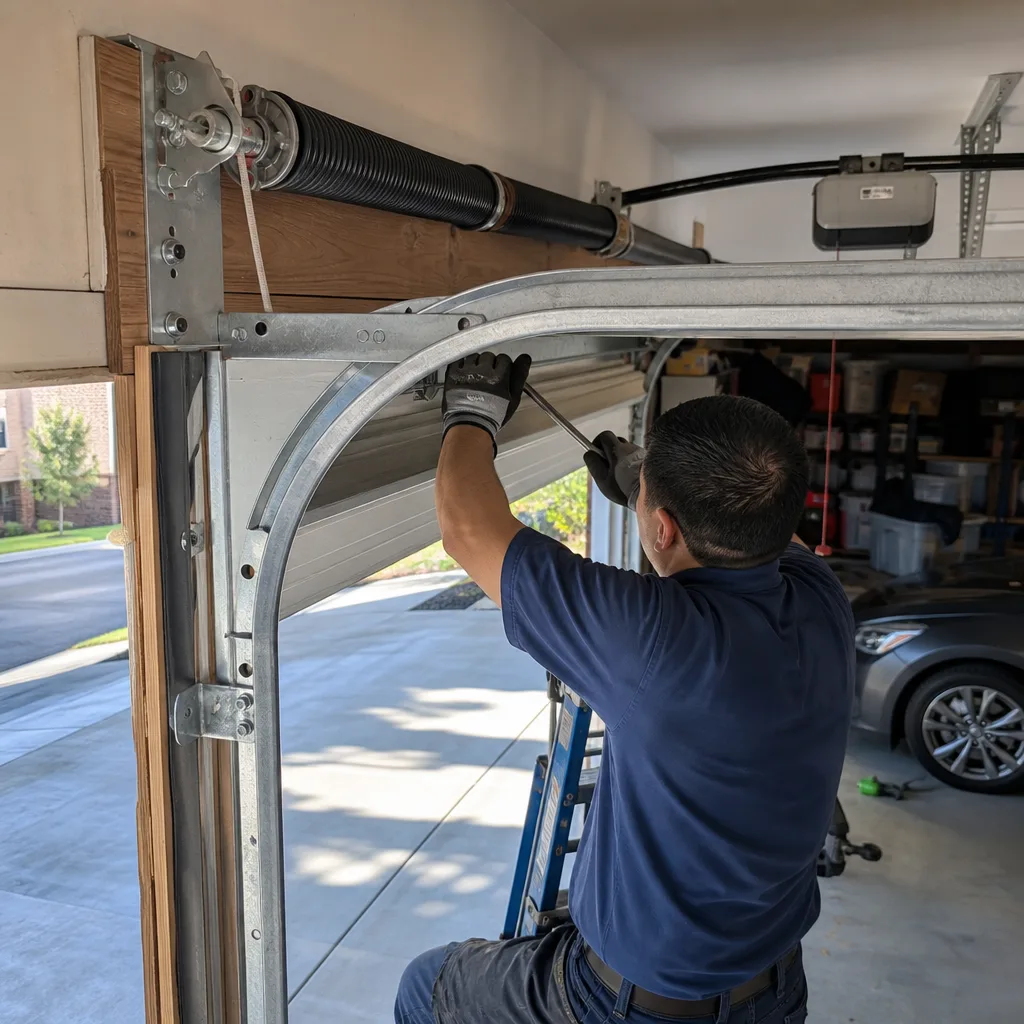
Look at the torsion spring assembly above the door (or the extension springs along the horizontal tracks, if that is your system). On torsion springs, look for a visible gap in the coil body. A gap of even an eighth-inch means a broken spring. Look for rust, paint flaking, or a powdery residue on the spring surface. These indicate metal fatigue.
Count the coils in the active winding. A spring that has lost tension will show more active coils than its original specification, meaning it has unwound slightly and is weaker. This requires experience to judge, but a noticeable change from your memory of the spring’s appearance is worth noting.
On extension spring systems, look for stretched or deformed springs, and check that the safety cable runs through the spring center. If the safety cable is missing or loose, the spring is dangerous - if it breaks, it can fly with lethal force.
Step 4: Check the Rollers and Track
Open the door manually (disconnect the opener first, if you know how - if not, observe during opener operation). Watch each roller as it enters and exits the curved section of track. Rollers should roll, not slide or bind. Nylon rollers wear flat spots; steel rollers develop rust and pitting. Either condition creates drag.
Look at the track itself. The vertical sections should be plumb. The horizontal sections should slope slightly toward the back of the garage. Check for dents, impact damage from vehicles, or separation at the track joints. In Celina, where hail is common, we’ve seen track damage from garage items falling during storms, not just from the door itself.
Step 5: Test the Balance
With the door disconnected from the opener and fully closed, lift it manually to waist height and release. A properly balanced door should stay in place or drift slowly. If it falls closed, the springs are weak. If it rises, they are too strong. Either condition strains the opener and indicates spring service is needed.
Do not perform this test if you observed cable damage, spring gaps, or track misalignment in steps 1-4. An unbalanced door with compromised hardware can drop or jam unexpectedly.
Step 6: Listen to the Opener
Reconnect and run a full cycle. Note any change in sound from your memory of normal operation. A change in pitch, duration, or rhythm means something has changed mechanically. The opener is telling you what it is struggling with.
Record what you observe. Specific observations - “cable slack on left side, door drifts down 6 inches when released at waist height” - get you faster, more accurate service than “it’s making a noise.”
Why Celina’s High-Use Households Face a Compressed Warning Window
Celina’s growth pattern creates a specific mechanical stress profile that shortens the time between first warning and failure. Understanding this helps homeowners in high-use households interpret symptoms with appropriate urgency; see more guides & resources for additional maintenance tips.
Three factors compress the warning window in Celina:
High cycle counts. Many Celina households run three or more vehicles through the garage daily, plus kids’ activities, home-based business deliveries, and equipment storage access. A standard garage door spring is rated for 10,000 cycles. At four cycles per day, that’s roughly seven years. At eight cycles per day, it’s three and a half. The warning signs - slight lag, minor noise change - appear in the final 500-1,000 cycles. For a low-use household, that’s months. For a high-use household in Celina’s Light Farms, Willow Bend, or Mustang Lakes developments, it’s weeks.
Thermal cycling. Celina sees temperature swings of 40 degrees or more between summer nights and peak afternoon heat. Metal springs expand and contract through this range. Each thermal cycle adds fatigue. A door in constant shade lasts longer than one on a west-facing garage that bakes from 2 PM to sunset. We’ve replaced springs in Celina’s newer developments where the garage has minimal overhang and full western exposure, and the failure pattern shows consistently earlier fatigue than shaded installations.
Dust and agricultural particulate. Celina’s location at the edge of active farmland means finer dust loads than urban Dallas or Plano. This dust infiltrates roller bearings, hinge pins, and opener logic boards. Dry rollers create drag that the opener compensates for until it cannot. The warning sign is not noise - it’s the opener working harder, which homeowners miss until the thermal overload trips.
For high-use households, we recommend the $89 Seasonal Garage Door Care for Celina tune-up twice yearly, in March and September. The inspection catches compressed-window failures before they strand a vehicle or trap a door closed. Our technicians are factory-familiar with all major brands including LiftMaster, Chamberlain, Genie, Clopay, Amarr, Wayne Dalton, Craftsman, and Raynor, and we stock the common spring and cable configurations for Celina’s most installed door models.
Three Warning Signs That Mean Stop Using the Door Immediately
Some symptoms permit continued limited use while scheduling service. Three do not. If you observe any of the following, disconnect the opener (pull the red emergency release cord if you can do so safely) and do not operate the door until a professional inspects it. There are no temporary workarounds. There is no safe way to “just get it open once more.”
1. Visible Cable Fraying or Broken Strands
A lift cable with visible broken wires is in the process of unlaying. When it fails, the full weight of the door transfers instantly to the opposite cable and spring. The door drops crooked, jams in the tracks, or falls free if the remaining cable also fails. Cables do not give reliable advance notice of the final strand breaking. What looks like “some wear” in morning light can part completely by evening.
In Celina, we’ve responded to cable failures where the homeowner had noticed fraying for two weeks and “meant to call.” The cable parted with the door halfway open, leaving a minivan trapped and the door hanging by one side. The repair was the same price it would have been two weeks earlier, but the inconvenience was avoidable.
2. A Broken or Gapped Torsion Spring
A torsion spring with any visible gap in its body is broken, even if the door still moves. The remaining spring (on a two-spring system) or the opener itself (on a single-spring system) is carrying the load. This is unstable and dangerous. The next operation can cause the broken spring section to unwind violently, or the door to drop if the remaining support fails.
Do not attempt to open or close the door. Do not pull the emergency release with the door in any position other than fully closed. The release disconnects the opener, and an unbalanced door will fall if not supported.
3. Door That Has Shifted or Jammed in the Tracks
If a roller has jumped the track, or the door is visibly crooked in the opening, stop. Continued operation will bend the track, damage door sections, and potentially pull the entire door free of its hardware. A jammed door is under uneven load. The cables and springs are not sharing tension as designed. One component is carrying more than its specification, and failure of that component is imminent.
We have seen homeowners in Celina attempt to “work the door free” by alternating opener and manual force. This bends the track beyond repair and converts a roller replacement into a full track and section replacement. The correct response is to stop, secure the area, and call for service.
For any of these three conditions, Mainspring Garage Door Co. home page has our contact information, or call directly. Our phones are staffed by a live person 24/7, including nights, weekends, and holidays. We do not use answering services. The person who answers can dispatch a technician and give you a realistic arrival window.
Seasonal Maintenance: When to Check and What to Look For
A structured inspection calendar prevents the missed warnings that lead to emergency calls. For Celina’s climate and use patterns, this schedule matches what we observe in the field.
March: Pre-Summer Inspection
Before the heat arrives, check for winter moisture damage. Look at the bottom seal for rodent chewing or dry rot. Inspect spring hardware for rust that started in humid winter conditions. Lubricate rollers, hinges, and bearings with a silicone-based product. Do not use WD-40 on door components; it attracts dust and gums up in heat.
Test the opener force settings. The door should reverse on contact with a 2×4 laid flat in the opening. If it does not, the force is set too high and the safety system is compromised. This is a required function, not a preference.
September: Post-Summer Recovery Check
After three months of thermal stress, inspect springs for coil separation or paint damage that indicates overheating. Check opener thermal overload history - if the opener has shut down from overheating, it has been working too hard. Find out why before it fails completely.
Clean photo-eye sensors. Dust accumulation from Celina’s dry late summer reduces beam strength and causes false reversals or failures to close.
Monthly: The 30-Second Listen
Once a month, stand in the garage and listen to a full open-close cycle. Note any change. Your ear is the most sensitive diagnostic tool you have, if you use it consistently. A change in sound is a change in condition. Document it. If the change persists for two consecutive months, schedule inspection.
Our $89 Seasonal Tune-Up covers all of the above with a written condition report. The 90-Day Done Right Promise applies: if anything we touch is not right, we return at no charge, with no paperwork or dispute process. It’s stated in writing on every job.
Common Mistakes to Avoid
- Fixing the squeak and ignoring the lag. A can of spray lubricant quiets a noisy door in five minutes. It does nothing for a spring losing tension. The quieted door gets ignored until the spring breaks. Address the mechanical cause of noise, not just the noise itself.
- Assuming a slow door means the opener is failing. Opener replacement is a significant expense. In our experience, 60% of “opener problems” in Celina are actually door balance or spring issues. Replacing a good opener on a failing door wastes money and leaves the real problem unaddressed.
- Testing springs or cables by touch. Never attempt to feel for spring tension, cable condition, or hardware tightness. These components store lethal energy. Visual inspection from a safe distance is the only homeowner-appropriate check.
- Ignoring neighborhood-specific patterns. In Celina’s newer developments with three-car garages and home-based businesses, doors wear faster than the 10,000-cycle rating assumes. Don’t compare your door’s age to a neighbor’s without comparing cycle counts.
- Waiting for “both springs to go.” On a two-spring system, when one spring breaks, the other is carrying double load and is now fatigued beyond its design. Replace both springs. The cost difference is minimal compared to a second service call, and the door will not balance correctly with one new and one worn spring.
- Accepting a verbal estimate for major repair. A written estimate protects both parties. Mainspring provides written, upfront pricing before any work begins. If a contractor will not put the price in writing, that is information about their business practices.
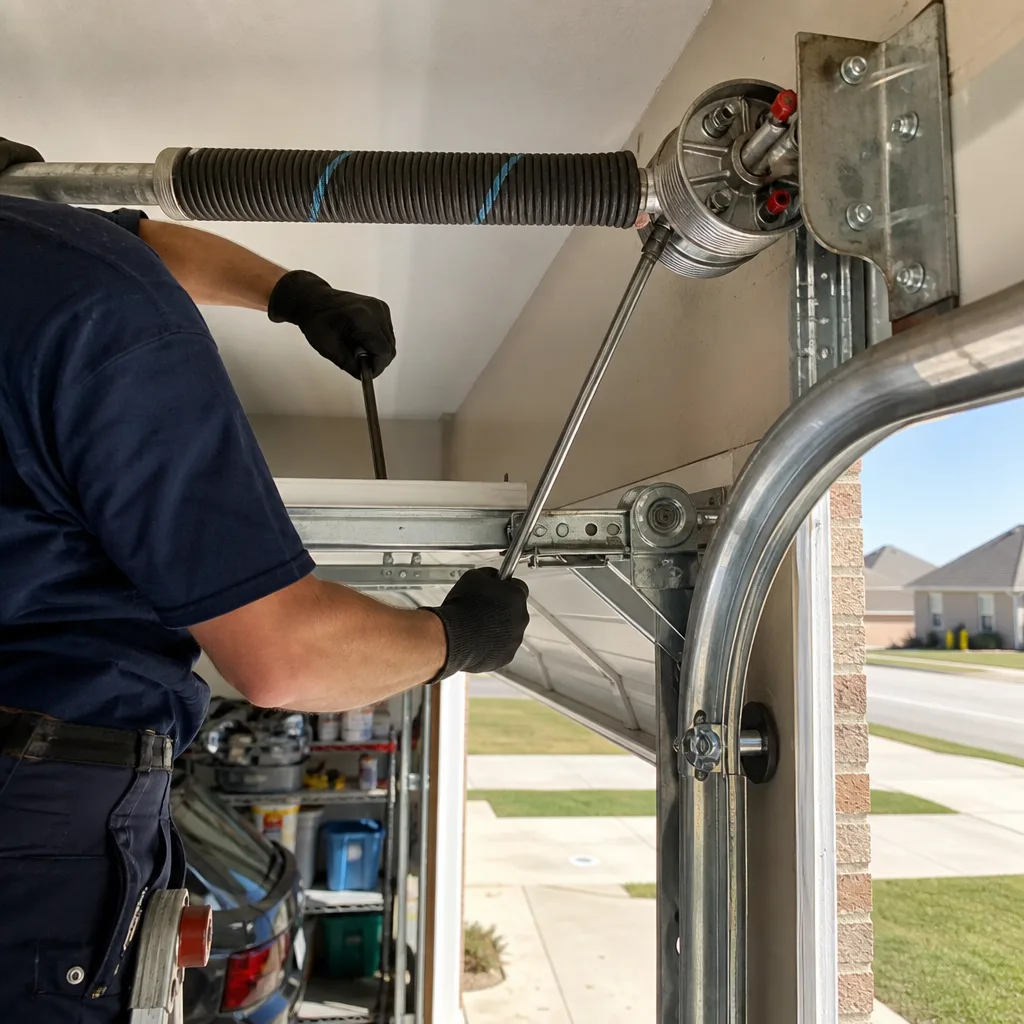
- DIY spring replacement from online tutorials. The tutorials exist. The injuries exist in greater numbers. Spring winding requires specialized tools, training, and an understanding of stored energy physics that cannot be acquired from a 12-minute video. This is not a cost-saving opportunity. It is a risk that professionals train years to manage safely.
When to Call a Professional
Call when you observe any structural symptom described in this guide: uneven door gap, cable slack or fraying, spring gaps, track misalignment, or opener behavior changes that indicate mechanical resistance. Call immediately for the three stop-now signs. Call for a seasonal inspection if your household runs high cycles or if your door is more than seven years old with no professional service history.
Mainspring Garage Door Co. offers free estimates in Celina. A technician arrives with a stocked truck, diagnoses the condition, and states a flat price before beginning work. Most repairs are completed in a single visit. The 90-Day Done Right Promise covers every job in writing. Call (214) 480-4855 to schedule.
Frequently Asked Questions
Spring replacement in Celina typically ranges from $180 to $340 for a standard two-car residential door, depending on spring size, cycle rating, and whether one or both springs require replacement. We state the exact price after inspection and before any work begins. Call (214) 480-4855 for a free estimate.
No. A door with a broken spring is unbalanced and dangerous. The opener or remaining spring is carrying an unsafe load. Continued use risks door drop, track damage, or opener failure. Disconnect the opener and call for service.
For standard use (2-4 cycles daily), annually. For high-use households or home-based businesses in Celina, every six months. The $89 Seasonal Tune-Up includes full inspection, lubrication, safety check, and written condition report.
No. Mainspring states the flat price before any work begins. If we discover additional issues during repair, we discuss them with you and get approval before proceeding. There are no surprises on the bill.
Yes. Our technicians arrive with springs, cables, rollers, hinges, and openers for all major brands. Most repairs are completed in a single visit. We are factory-familiar with LiftMaster, Chamberlain, Genie, Clopay, Amarr, Wayne Dalton, Craftsman, and Raynor systems.
Disconnect the opener and try to lift the door manually. If it is heavy, unbalanced, or does not stay in place, the problem is the door’s spring system. If the door moves smoothly but the opener still behaves abnormally, the problem is likely in the opener. Our technicians diagnose both components and recommend the correct repair, not the most expensive one.
The Bottom Line
A garage door gives clear warnings before it fails. The skill is learning which warnings matter. Cosmetic noise is a maintenance reminder. Structural lag, cable slack, and uneven travel are safety alerts with a closing window. In Celina’s high-heat, high-use environment, that window is shorter than most homeowners expect. The 90-second inspection path, the opener diagnostic signals, and the three stop-now signs in this guide give you the same starting point our technicians use. Use it monthly. Document changes. Call when the symptom points to structure, not just sound. A door that is maintained on schedule and repaired at the first structural warning will outlast two doors that are ignored until failure.
Written by Carl Dutton, Owner at Mainspring Garage Door Co., serving Celina since 2016.